UHF RFID Jewelry Tags for Inventory Accuracy and Loss Prevention
Jewelry inventory combines high unit value, small item size, frequent handling, and a strong need for trustworthy records. Manual counts can interrupt selling time while still leaving uncertainty about an item's location or status. UHF RFID jewelry tags give each ring, necklace, bracelet, watch, or display item a machine-readable identity that can be read quickly in a defined zone.
For retailers, manufacturers, and distributors, the value is not a generic promise of smart inventory. It is a repeatable way to support receiving, cycle counting, display replenishment, inter-store transfers, and exception review. This guide explains how to select and test RFID jewelry tags for a practical B2B inventory workflow.
How Do UHF RFID Jewelry Tags Improve Inventory Control?
Create an Item Level Jewelry Identity
Each tag can be encoded with a unique EPC and linked in the authorized inventory system to a SKU, serial number, collection, location, and item status. This creates a consistent identifier as an item moves between receiving, back-room storage, display, transfer, repair, and sale.
The RFID tag identifies the tagged item within reader coverage. Product authentication, custody approval, payment controls, and investigation procedures remain separate parts of the inventory and security program.
Accelerate Cycle Counts and Display Checks
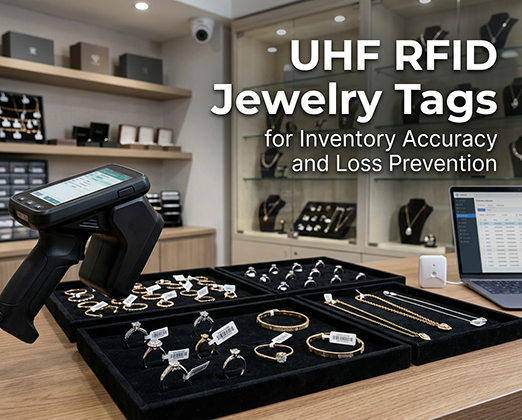
Handheld readers can help teams capture multiple tagged items across trays, cabinets, back rooms, and transfer cartons without manually scanning each printed barcode. The resulting observation list can be compared with the expected location list to identify items that need review.
A controlled count process should create an exception list for missing, unexpected, duplicate, or unreadable IDs. It should not silently overwrite the inventory record based on a single read session.
Support Controlled Receiving and Transfers
Fixed or desktop read points can support receiving, packing, or transfer confirmation when the surrounding RF environment is designed for the workflow. Define when custody changes, who confirms the transaction, and how staff resolve a missing or unexpected read.
Different RFID jewelry labels can be selected according to the item presentation, attachment method, required print fields, reader setup, and regional UHF band.
Which RFID Jewelry Tag Fits the Item and Read Point?
Choose a Tag That Preserves Product Presentation
The tag should fit the item without obscuring presentation, damaging a delicate surface, or creating an awkward customer experience. Buyers should define loop length, tag face size, attachment material, printed price or product fields, barcode or QR backup, and whether the tag attaches to a display card, pouch, or the item itself.
A UHF jewelry label can be supplied in a loop or hangtag-style format for item-level identification, but the final attachment method should be sampled on representative products before ordering at scale.
Test Performance Near Metal and Dense Displays
Jewelry materials, closely spaced items, metal display fixtures, foil packaging, and the orientation of the tag can all affect UHF performance. A tag that reads well on a single product may behave differently in a crowded tray or cabinet.
Test representative jewelry, packaging, display density, reader settings, and counting distance. A controlled read zone that reliably captures the intended items is more valuable than a nominal maximum read-range claim.
Plan the Reader and Tag as One System
The tag is only one part of the workflow. Reader selection, antenna placement, shielding, power settings, inventory software, and staff procedures affect count quality. Review available RFID hardware together with the selected jewelry tag and the intended read point.
| Selection Factor | What to Define | Why It Matters |
|---|
| Item presentation | Ring, necklace, bracelet, watch, display card, pouch, or package | Determines tag shape, loop length, and attachment method |
| Material environment | Metal content, stones, packaging, display fixtures, and tray density | Changes UHF antenna behavior and practical read accuracy |
| Read point | Handheld count, desktop station, cabinet, receiving desk, or transfer carton | Defines reader, antenna, and read-zone requirements |
| Visual data | Price, SKU, serial number, barcode, QR code, logo, and language | Supports staff handling and customer-facing presentation |
| Data workflow | EPC sequence, mapping file, status rules, location records, and transfer approval | Turns tag reads into auditable inventory events |
How Should Buyers Specify Chip and Data Requirements?
Select the Chip with the Complete Tag Construction
Chip choice should follow the required protocol, available memory, regional UHF configuration, reader compatibility, selected antenna, and tested performance on the intended jewelry and display environment. Relevant UHF options can include NXP UCODE® 8, NXP UCODE® 9, Impinj Monza® R6, Impinj Monza® R6-P, Impinj M730™, Impinj M750™, Alien Higgs™-4, and Alien Higgs™-9. Product names are trademarks of their respective owners.
Confirm the exact chip, tag construction, and memory configuration in the approved bill of materials. Availability and final read performance should be verified with representative samples before a production release.
Define an Auditable Identifier Workflow
An EPC, serial number, user memory, or tag password is not a complete anti-counterfeiting or loss-prevention program. Buyers should define identifier allocation, encoding authority, duplicate-ID prevention, data-file format, backend validation, status changes, deactivation, and the process for damaged or replaced tags.
RFID can support loss-control workflows by improving inventory visibility and exception review. It should complement, not replace, existing product authentication, access control, CCTV, secure display, custody, and reconciliation procedures.
How Can Jewelry Businesses Build a Reliable RFID Counting Workflow?
Define Locations and Item Statuses
Start with named locations and clear item statuses, such as available, on display, reserved, transferred, sold, repair, and exception. The inventory system should define which status changes are allowed at each location and who can approve them.
Run a Representative Pilot
Pilot the selected tag on representative jewelry, packaging, fixtures, and display density. Test receiving, cycle counts, cabinet counts, transfer confirmation, and exception handling under normal operating conditions.
Agree the minimum acceptable read rate, the handling of unreadable or duplicate tags, and the process for reconciling mismatches before ordering at scale.
Verify Integration Before Rollout
Verify that tag identifiers and mapping files import correctly into the inventory system and that read events can be associated with the intended location and status. Document reader settings, count instructions, tag placement, and the final approved tag configuration so the process can be repeated across stores or facilities.
FAQ
Can UHF RFID Tags Identify Individual Jewelry Items?
Yes. Each tag can be encoded with a unique EPC and linked to a separate authorized inventory record. The reliability of the workflow depends on correct encoding, attachment, reader configuration, and inventory-system controls.
Can RFID Jewelry Tags Work Near Metal Jewelry?
They can, but tag construction, placement, orientation, and display density must be tested on the actual products. Metal and closely spaced items can change UHF read performance.
Can Tags Be Encoded Before Shipment?
Yes. Suppliers can provide serialized EPC encoding, printed identifiers, and matching data files when the data format, encoding sequence, and approval process are defined in advance.
Do RFID Jewelry Tags Prevent Theft?
RFID can support inventory visibility, transfer confirmation, and exception review. It does not by itself prevent theft or authenticate a product. Use it alongside appropriate physical security, custody, access-control, and reconciliation procedures.
Conclusion
UHF RFID jewelry tags can help jewelry businesses improve inventory accuracy and loss-control workflows when the tag format, read point, reader setup, data model, and exception process are designed as one system. The best procurement decision is based on a representative pilot with the actual products and display environment.
For help matching UHF RFID jewelry tags to your inventory workflow, contact ZDRFID with item dimensions, display photos, operating region, target read method, integration requirements, and forecast quantity.
















 UHF RFID Jewelry Tags for Inventory Accuracy and Loss Prevention