RFID Waste Bin Tags for Smart Collection and Municipal Asset Management
Waste operators and municipalities need a durable way to identify collection bins across routes, neighborhoods, depots, and service contracts. Printed numbers can fade, manual lists are difficult to maintain, and unverified service events can create disputes. RFID waste bin tags provide a machine-readable identifier that can be linked to a bin asset record and captured at a defined collection or maintenance point.
The value is not simply putting a tag on every bin. A successful program connects a durable tag, reader equipment, collection workflow, and asset-management system. This guide explains how RFID bin tags can support collection verification, bin asset control, maintenance history, and exception management.
How Do RFID Waste Bin Tags Support Smart Collection?
Give Each Bin a Stable Asset Identity
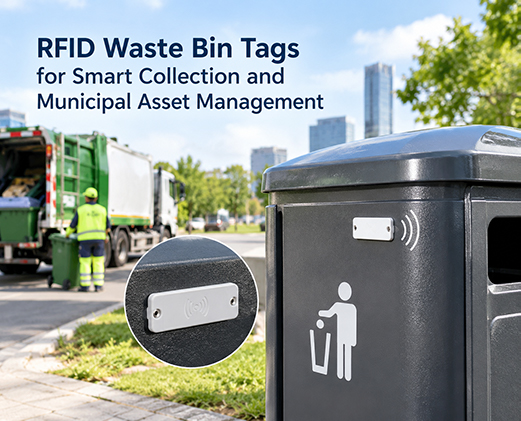
An RFID bin tag can be associated with an asset record containing the bin type, capacity, owner, service point, deployment date, maintenance status, and replacement history. This gives operators a more consistent way to identify containers as they move between customers, routes, depots, repair areas, and storage locations.
The tag carries an identifier. The service history, customer information, route records, and billing logic should remain governed by the authorized operational platform.
Support Collection Verification Workflows
A reader installed at a lift, vehicle, depot, or maintenance point can capture the bin identifier. The backend system can associate that read with a time, vehicle, route, operator, lift signal, or other approved collection data.
A tag read alone should not automatically be treated as proof that a bin was emptied. The service workflow should distinguish between an observed tag, a valid lift event, a completed collection event, and an exception requiring review.
Improve Route Accountability and Exception Review
RFID events can help operators investigate missed collections, damaged bins, reassigned containers, duplicate IDs, or disputed service records. The practical benefit is stronger operational evidence when tag reads are combined with route and lift data under a defined process.
For broader operational planning, RFID bin identification can be linked to RFID asset management solutions that support the identification and maintenance of distributed physical assets.
Which RFID Bin Tag Construction Fits Outdoor Collection?
Specify for Outdoor Exposure and Bin Material
Waste bins may experience UV exposure, rain, dirt, cleaning chemicals, impacts, flexing, seasonal temperature change, and repeated lifting. Buyers should define the bin material, mounting recess or flat area, fastening method, expected service life, washdown conditions, and local operating environment.
Request the applicable product data sheet and test the mounted tag under representative conditions. A generic waterproof claim is not enough without confirming the enclosure, mounting method, and expected outdoor exposure.
Select Frequency for the Collection Architecture
LF, HF, and UHF can suit different collection architectures. Frequency selection should follow the existing or planned reader, required read zone, reader-to-bin geometry, interference conditions, regional requirements, and desired workflow rather than a generic maximum-distance claim.
UHF may suit longer-range or multi-tag read points. LF or HF may be appropriate for close-range identification. The final choice should be validated using the actual collection vehicle, lift position, bin design, and operating route.
Choose a Secure Mounting Method
Existing bins can often be retrofitted when they have a compatible mounting area. Options can include recessed installation, screws, rivets, adhesive, or a dedicated mounting feature. The method should be selected to balance retention, maintenance access, bin cleaning, and replacement procedures.
For related rugged and outdoor identification options, review ZD RFID tag products together with the intended bin material and reader design.
| Selection Factor | What to Define | Why It Matters |
|---|
| Bin construction | Plastic type, metal content, recessed area, flat area, and bin capacity | Determines tag form factor and mounting method |
| Outdoor exposure | UV, rain, cleaning chemicals, impact, flexing, and washdown | Defines enclosure and retention requirements |
| Read point | Vehicle lift, depot, maintenance station, handheld audit, or transfer point | Defines reader, antenna, and practical read-zone requirements |
| Service workflow | Route, lift signal, timestamp, operator action, and offline-data handling | Distinguishes a tag read from a validated service event |
| Asset data | Identifier, owner, address, bin type, capacity, status, and replacement history | Builds a reliable bin asset record |
How Should Operators Specify Chip and Data Requirements?
Select the Chip as Part of the Complete Tag Design
Chip selection should follow the required frequency, protocol, memory, reader compatibility, regional configuration, tag antenna, enclosure, and tested performance on the installed bin. Relevant UHF options can include NXP UCODE® 8, NXP UCODE® 9, Impinj Monza® R6, Impinj Monza® R6-P, Impinj M730™, Impinj M750™, Alien Higgs™-4, and Alien Higgs™-9. Product names are trademarks of their respective owners.
Confirm the exact chip, memory configuration, tag construction, and identifier format in the approved bill of materials. Availability and final read performance should be validated through a representative pilot.
Build an Auditable Bin Identifier Workflow
Assign one stable identifier to each bin and map it to the authorized asset record. Define identifier allocation, encoding authority, duplicate-ID prevention, data-file format, bin commissioning, reassignment, replacement, and deactivation procedures.
A tag ID, EPC, or password is not a complete security or billing-control program. Billing, service validation, and customer disputes should be governed by the operational system and approved business rules.
How Should RFID Bin Tags Be Tested Before Fleet Rollout?
Test the Real Collection Cycle
Test the final tag and mounting method on representative bins after normal handling, washing, impact, and outdoor exposure. Validate read performance at realistic vehicle speeds, lift positions, weather conditions, and load states.
The pilot should include the actual reader, antenna, controller, route workflow, and software interface. A bench demonstration does not replace field testing on the collection vehicle.
Define Acceptance Criteria Before Volume Deployment
Agree the acceptable tag-retention rate, read performance, data-file accuracy, duplicate-ID controls, and exception-handling process before thousands of bins are tagged. Define how damaged bins, unreadable tags, offline collection records, and replacement containers are processed.
Document the Approved Configuration
Record the tag construction, chip, mounting location, fastening method, identifier sequence, reader settings, collection logic, and pilot acceptance results. This makes the deployment repeatable across routes, depots, and service regions.
Review available RFID hardware as part of the complete collection system rather than as a separate purchasing decision.
FAQ
Are RFID Bin Tags Waterproof?
The selected enclosure and installation method must be specified for the outdoor environment. Request the product data sheet and test the tag after installation on the actual bin, including relevant cleaning and handling conditions.
Can an RFID Tag Be Installed on an Existing Bin?
Often yes, provided the bin has a compatible mounting area and fastening approach. Inspect the bin material, wall thickness, recess, cleaning process, and expected handling conditions before selecting a retrofit method.
Does RFID Prove That a Bin Was Emptied?
RFID identifies the bin. A valid collection record should combine the tag read with approved lift, route, time, vehicle, or sensor logic according to the operator's service-validation process.
Can RFID Bin Tags Be Encoded Before Shipment?
Yes. Suppliers can provide serialized encoding and matching data files when the identifier sequence, data format, approval process, and commissioning workflow are defined in advance.
Conclusion
RFID waste bin tags can improve collection verification and municipal bin asset management when the tag construction, mounting method, reader setup, data model, and exception process are designed as one system. The strongest deployment begins with a representative field pilot rather than a generic read-range claim.
For help selecting RFID waste bin tags for a collection program, contact ZDRFID with bin photos, material, mounting area, reader details, operating region, service workflow, and expected quantity.


















 RFID Waste Bin Tags for Smart Collection and Municipal Asset Management