The value is not simply adding a digital label to a shelf. When linked to a controlled kanban workflow, NFC can support bin verification, replenishment requests, material-location control, and an audit trail at the physical point where the signal originates. This guide explains how manufacturers can specify, test, and scale NFC RFID shelf labels for industrial kanban.
How Do NFC RFID Shelf Labels Support Industrial Kanban?
Create a Controlled Replenishment Signal
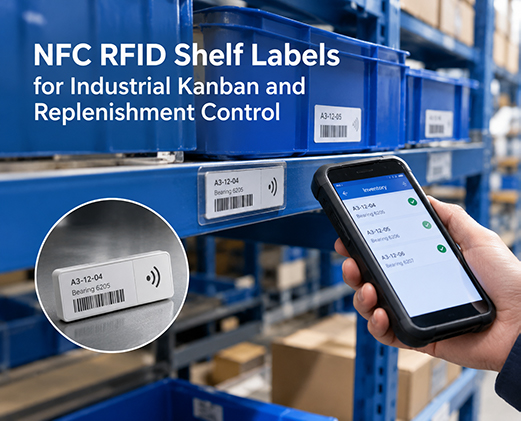
NFC is designed for close-range interaction. At a shelf, rack, two-bin station, or point-of-use location, this can be an advantage because the operator intentionally confirms one specific label rather than reading many nearby labels at the same time.
A tap can retrieve the approved bin record, open a replenishment form, display work instructions, or submit a request to middleware. The exact result depends on the app, reader, and system integration selected for the project.
Verify the Physical Bin and Material Location
An NFC shelf label can be linked to a bin number, part number, storage location, approved container rule, and replenishment workflow. This helps operators verify that they are acting on the intended material location before a request is sent.
The label is an identifier at the point of use. It does not replace material-planning logic, inventory accuracy controls, supplier schedules, or production authorization rules in the ERP, MES, WMS, or kanban platform.
Build an Auditable Kanban Event
A useful replenishment event captures more than “tag tapped.” Define the location, bin or part number, requested quantity or container rule, timestamp, device or operator context where appropriate, and the exception path.
The platform should reject inactive, duplicated, or unauthorized identifiers and show the operator a clear confirmation. If a physical kanban card remains part of the process, define which record is authoritative so that paper and digital instructions do not drift.
Why Does NFC Fit Controlled Replenishment Points?
Use Intentional Close-Range Reading
NFC normally operates at 13.56 MHz and is intended for close-range interaction. This is useful where a worker must confirm a specific shelf or bin before creating a replenishment request. It is not designed for long-range bulk inventory reading or automatic pallet identification.
For processes that require reading many labels at a distance, UHF RFID may be a better fit. For a shelf-level kanban signal where the operator deliberately identifies one location, NFC can provide a simple and focused interaction.
Support Compatible Mobile Devices and Readers
Many modern mobile devices support NFC, but compatibility should be confirmed with the final phone model, operating system, application, and security configuration. Some industrial workflows may require dedicated scanners or fixed NFC readers rather than personal smartphones.
The pilot should test the complete user journey: label detection, app or web launch, user authentication, data validation, request submission, system response, and replenishment confirmation.
Plan for Metal Racks and Industrial Surfaces
Standard NFC labels can be affected by metal racks, cabinets, equipment, and conductive surfaces. An on-metal NFC construction or an appropriate spacing layer may be required to maintain reliable performance after installation.
A smart interaction NFC sticker with an anti-metal layer can be evaluated for industrial shelves, equipment, and conductive surfaces. Final performance should be tested on the installed rack, not only on a sample sheet.
| Selection Factor | What to Define | Why It Matters |
|---|
| Mounting surface | Plastic bin, painted rack, bare metal, cabinet, or machine surface | Determines whether a standard or on-metal NFC construction is required |
| Operator device | Phone model, industrial scanner, fixed reader, app, and authentication method | Confirms compatibility with the planned workflow |
| Label construction | Label size, face material, adhesive, abrasion resistance, cleaning exposure, and print fields | Defines durability and usability in daily production |
| Kanban event | Part number, bin ID, location, quantity rule, operator context, and exception path | Turns a tap into an actionable replenishment request |
| System interface | ERP, MES, WMS, kanban platform, middleware, and approval process | Ensures the signal reaches the correct planning workflow |
How Should Buyers Specify Chip and Data Requirements?
Select the Chip for the Required Workflow
Chip selection should follow the required protocol, memory, NDEF content, security requirement, reader compatibility, label construction, and final mounting surface. Relevant NFC and HF options can include NXP NTAG® 213, NXP NTAG® 215, NXP NTAG® 216, NXP NTAG® 424 DNA, NXP ICODE® SLIX, NXP MIFARE Ultralight® EV1, and NXP MIFARE DESFire® EV2 or EV3. Product names are trademarks of their respective owners.
Confirm the exact chip, memory configuration, on-metal layer if required, encoding format, and lock settings in the approved bill of materials. Chip availability and final reading performance should be verified through representative samples.
Keep Sensitive Operational Data in the System
Avoid storing confidential production, customer, or planning information directly on the label unless the access-control model and data policy support it. In many kanban applications, the label stores a unique identifier or limited NDEF reference while the approved system controls the current material and replenishment data.
Define identifier allocation, encoding authority, duplicate-ID prevention, app permissions, inactive-label handling, and replacement procedures. A UID, NDEF record, or password is not a complete access-control or cybersecurity program by itself.
How Should NFC Shelf Labels Be Tested Before Rollout?
Test the Installed Surface and Daily Handling
Test the final label after mounting on representative shelves, bins, racks, or machines. Include the actual cleaning process, expected abrasion, temperature exposure, operator gloves, lighting, and normal production handling.
If labels are mounted on metal, confirm that the selected on-metal construction or spacer provides consistent reading performance at the final installation position.
Validate the Complete Replenishment Workflow
A pilot should follow the full process from an empty-bin signal through replenishment approval, material delivery, and closure. Test inactive labels, duplicate identifiers, poor connectivity, incorrect scans, and the procedure for a missing or damaged label.
Agree acceptance criteria for label retention, read success, response time, encoding accuracy, system integration, and operator instructions before expanding to multiple lines or sites.
Document the Approved Configuration
Record the label construction, chip, mounting position, print layout, identifier sequence, application settings, reader or mobile-device model, and workflow rules. This supports repeatable implementation across production lines and facilities.
Explore RFID inlays and labels and RFID hardware as part of the complete kanban solution.
FAQ
Can a Phone Read an NFC Shelf Label?
Many NFC-enabled phones can read compatible labels, but the final phone model, operating system, app or web flow, device-management policy, and required authentication should be tested before rollout.
Can NFC Labels Work on Metal Racks?
Yes, when an on-metal NFC construction or an appropriate spacer is selected and tested on the installed surface. Standard NFC labels may perform poorly when placed directly on metal.
Can NFC Shelf Labels Be Printed and Encoded Before Shipment?
Yes. Custom printing, serialized encoding, NDEF records, and matching data files can be supplied when the artwork, identifier format, data content, and approval process are defined in advance.
Does an NFC Tap Automatically Create a Replenishment Order?
Not by itself. An NFC tap identifies the label and can start a request workflow. The connected application or middleware must apply the approved part, quantity, authorization, and planning rules before a replenishment action is created.
Conclusion
NFC RFID shelf labels can improve industrial kanban control when the label construction, mounting surface, operator device, application workflow, and system integration are designed as one process. NFC is especially useful for deliberate, close-range confirmation at a specific shelf or bin location.
For help matching NFC shelf labels to an industrial kanban workflow, contact ZDRFID with bin dimensions, mounting surface, artwork, mobile-device or reader setup, system interface, and expected quantity.

















 NFC RFID Shelf Labels for Industrial Kanban and Replenishment Control