An RFID identity card combines personal identification details with contactless technology in a single card. For businesses sourcing cards for employee identification and daily operations, the key is choosing a product that fits the intended application and existing system.
What Is an RFID Identity Card?
How RFID Identity Cards Work
An RFID identity card contains an electronic chip and an antenna embedded in the card body. When presented to a compatible RFID/NFC Reader, the card communicates wirelessly with the device. The connected system then processes the credential according to its configured rules.
Depending on the chip and system configuration, RFID identity cards can support employee identification, access control, and attendance recording. Businesses can compare available formats and technologies in these RFID card products.
RFID Frequencies
Frequency is a key specification because the card must be compatible with the intended reader. Cards that look identical may use different technologies and may not work with the same equipment.
| Technology | Typical applications | Key compatibility checks |
|---|
| 125 kHz RFID | Basic access control and attendance systems | Frequency and chip type |
| 13.56 MHz RFID | Smart cards and access control | Chip model and communication protocol |
| NFC | Contactless identification and supported mobile applications | NFC compatibility and application requirements |
NFC commonly operates at 13.56 MHz, but not every card using this frequency supports every NFC function. Compatibility depends on the chip, communication protocol, reader, and application.
How Do You Choose the Right RFID Identity Card?
Reader and Chip Compatibility
Start by identifying the frequency, supported protocols, and software used by the Existing Reader System. If the cards will be used across multiple locations, verify compatibility with each reader type before placing a bulk order.
The chip also affects the card's capabilities. MIFARE® Classic 1K is used in some access control and attendance systems. MIFARE® DESFire® EV2 and EV3 provide more advanced security capabilities, while NTAG® 213, NTAG® 215, and NTAG® 216 are options for supported NFC applications.
These chip types are not interchangeable in every system. Confirm the exact chip model and required functions with the supplier before approving production.
Card Materials and Thickness
PVC is commonly used for employee identity cards. PET and ABS are also available for certain product configurations. The appropriate material depends on the required appearance, handling conditions, and product design.
Standard CR80 cards measure 85.5 × 54 mm. However, thickness varies by product. The RFID access control badge listed on the manufacturer's website has a standard thickness of 0.76 mm, while the custom NFC badge page lists thickness options of 0.84 mm, 0.9 mm, and customized sizes.
These specifications apply to different products and should not be treated as universal standards. If the cards need to fit existing holders or work with a particular RFID/NFC Reader, test a sample before ordering in bulk.
Printing and Chip Encoding
An employee identity card can display a photo, name, department, employee number, and company logo. Depending on the application, buyers may also request a barcode, QR code, or serial number.
Printed information and electronic data should be specified separately. The chip may store an identifier or other supported data, while access permissions are often managed by the connected software. Before production, confirm which details need to be printed, which data must be encoded, and how the Existing Reader System will process the credential.
For projects requiring personalized printing and supported NFC chip options, review the custom NFC badge.
Where Are RFID Identity Cards Used?
Office Access Control
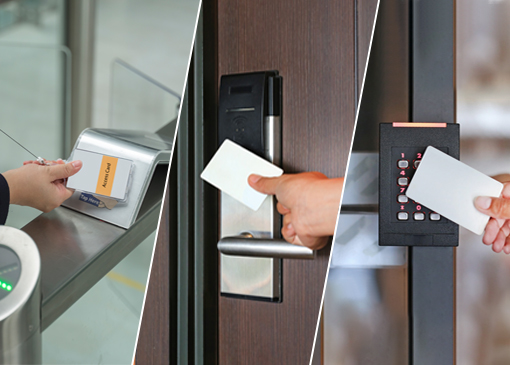
In offices and commercial buildings, RFID identity cards can provide access to entrances, meeting areas, and restricted rooms. The access control system can assign permissions according to an employee's role or department.
Compatible systems may also use the cards for attendance recording. Before deployment, confirm that the cards, readers, and software support the intended functions.
Industrial and Campus Identification
Factories may use RFID identity cards to manage employee entry to production areas, warehouses, and restricted facilities. Schools and laboratories can use them to identify staff and control access to designated spaces.
The card itself does not determine who can enter each area. The access control system must be configured with the appropriate permissions, and the complete setup should be tested before use.
Event and Visitor Identification
RFID identity cards can support event registration and visitor identification. NFC enabled cards may also provide additional functions when used with compatible devices and software.
For projects involving cards, readers, smart locks, or turnstiles, review the access control solution to understand how the equipment and software can work together.
What Should Buyers Check Before Ordering RFID Identity Cards?
Specification Confirmation
Before requesting a quotation, prepare the required frequency, chip model, dimensions, thickness, material, printing design, and order quantity. If encoding is required, provide the relevant technical specifications and clarify who will manage the process.
Also confirm whether the order includes individual employee details, accessories, or other personalization. Clear requirements help the supplier assess the project and provide an appropriate quotation.
Sample Testing
Test a sample with the actual RFID/NFC Reader and software that will be used after deployment. Check whether the card is recognized consistently and whether the required functions work as expected.
Review print quality, dimensions, surface finish, and compatibility with card holders. If the cards will be exposed to specific environmental conditions or frequent handling, discuss suitable material options with the supplier.
Security and Data Protection
Security depends more on the physical card. Buyers should consider the chip's capabilities, authentication method, reader configuration, access permissions, and management of security keys where applicable.
Employee information also needs appropriate protection. Decide which details should appear on the card, which information should be stored electronically, and who should be allowed to access it.
Conclusion
Choose a card that matches your reader system, security requirements, and customization needs. Confirm the specifications and test samples before bulk production.
For help with card selection and customization, contact our team to discuss your requirements.

















 RFID Chip Bracelet Selection Guide: Choosing the Right Chip, Frequency, and Material